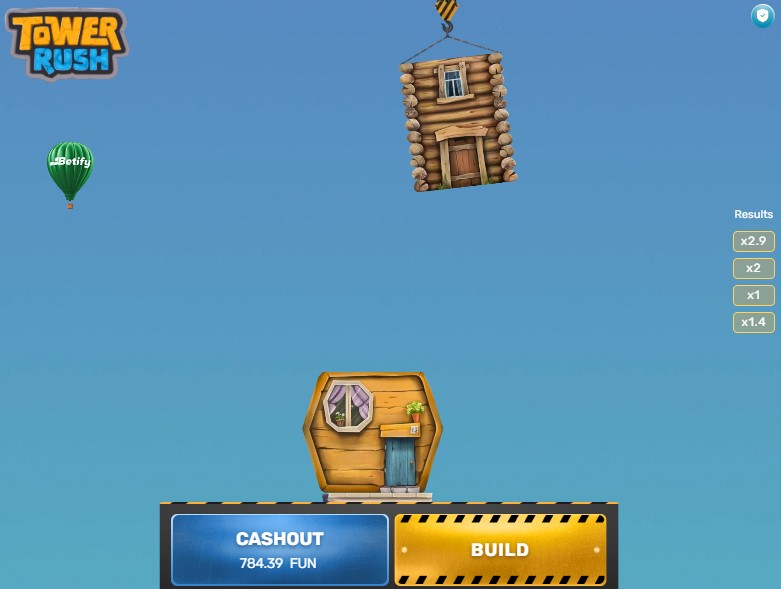
The Multiplier: Up to x100 — but how realistic is it?
Tower Rush offers a maximum multiplier of x100. With a bet of €100, that would mean a €10,000 win from a single round. That sounds tempting — but how often does that actually happen?
In our 200 test rounds, we observed the following distribution:
| Multiplier | Frequency (approx.) | Comment |
|---|---|---|
| x1–x2 | 65% of all rounds | Base level, low wins |
| x2–x5 | 22 % | Solid wins |
| x5–x10 | 8 % | Good rounds |
| x10–x25 | 3,5 % | Rare highlights |
| x25–x50 | 1 % | Very rare |
| x50–x100 | 0,5 % | Extremely rare |
In 200 rounds, we reached x42 once (with Temple Floor Bonus) and x28 once (without bonus). x100 was never reached. This confirms what the math says: The maximum multiplier is achievable, but it is a statistical outlier.
For comparison: Rabbit Road by Inout Games has a theoretical maximum multiplier of x3,608,855 — an astronomical number that practically never occurs. Tower Rush is much more realistic with x100, and you more frequently hit the x5–x25 range, which is the sweet spot for most players.
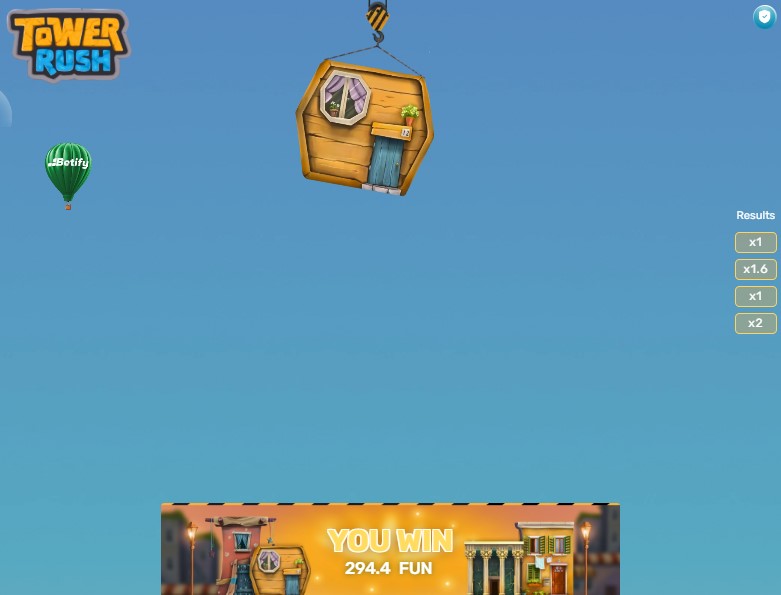
The RTP of Tower Rush: 96.12% to 97%
The RTP indicates how much percentage of all bets is returned to players in the long run. For Tower Rush, this value ranges from 96.12% to 97% — depending on the source and configuration. This means: Of every €100 wagered in total, statistically €96.12 to €97 is returned as winnings. The casino keeps €3 to €3.88.
Why a range and not a fixed value? Tower Rush has three in-game bonuses (Frozen Floor, Temple Floor, Triple Build), whose frequency and impact slightly shift the effective RTP. If the Temple Floor occurs frequently and delivers high multipliers, the RTP approaches 97%. In sessions without bonus events, it is closer to 96.12%.
For the individual player, the RTP is a long-term metric — it applies over thousands of rounds. In a single session of 50 rounds, the actual return can be 40% (bad streak) or 200% (lucky streak). Only over many sessions does the result align with the theoretical RTP.
Nevertheless, the RTP is the most important comparison value. A game with 97% RTP returns more to players in the long run than one with 94%. And Tower Rush ranks at the top in this regard.
| Game | Developer | RTP | Difference to Tower Rush |
|---|---|---|---|
| Tower Rush | Galaxsys | 96–97% | Reference |
| Aviator | Spribe | 97 % | ±0% |
| Spaceman | Pragmatic Play | 96,5 % | -0,5 % |
| Uncrossable Rush | Evoplay | 96 % | -1 % |
| Rabbit Road | Inout Games | 95,5 % | -1,5 % |
| MegaBlock | Inout Games | 95,5 % | -1,5 % |
| Squid Gamebler | Inout Games | 94 % | -3 % |
| Plinko | Spribe | 99 % | +2 % |
Tower Rush shares the top position with Aviator (97%). The only common casino title with a higher RTP is Plinko (99%), which, however, offers significantly lower multipliers and has no skill factor.
The 3% difference between Tower Rush (97%) and Squid Gamebler (94%) may sound small, but it amounts to a difference of €30 over a stake of €1,000. Over ten sessions with a stake of €100 each, that's €300 less return with Squid Gamebler. In the long run, this adds up significantly.
Volatility describes how much the results fluctuate around the average. Low volatility means: many small wins, few large losses. High volatility means: rare but big wins, with longer losing streaks in between.
Tower Rush is classified as "medium to high." In practice, this means:
Medium volatility is evidentin the lower levels of the tower. The first five to eight blocks are often successful — the multipliers are low (x1.2 to x3), but the win frequency is high. Those who regularly cash out at x2 or x3 experience a relatively stable session with many small wins.
High volatility is evidentfrom the tenth floor upwards. The blocks become narrower, the precision requirement increases, and the multiplier climbs faster. Those aiming for x20, x50, or even x100 experience long dry spells with many failed attempts — but a single hit can compensate for the losses multiple times over.
The player controls the effective volatility themselves: By choosing the cashout timing, they decide whether to play low-volatility (early cashout) or high-volatility (late cashout). This is an advantage over slots, where the volatility is set by the developer and cannot be influenced by the player.
| Cashout Strategy | Typical Multi | Win Frequency | Volatility | Profile |
|---|---|---|---|---|
| Early (x1.5–x2) | Low | Very high (~70%) | Low | Conservative |
| Medium (x3–x5) | Medium | Medium (~40%) | Medium | Balanced |
| Late (x10–x25) | High | Low (~15%) | High | Risk-seeking |
| Extreme (x50–x100) | Very high | Very low (~3%) | Very high | Highroller |
The percentages are approximations from our tests over 200 rounds in real money mode. They are not a guarantee but provide a realistic orientation.
What sets Tower Rush apart from other crash games are the three integrated bonus mechanics. They appear randomly during the game and directly influence the winning chances.
Frozen Floor— The current block is automatically placed perfectly. No risk of a misplacement on this floor. Particularly valuable from floor 10+, when the blocks become narrower. Estimated frequency: every 4–6 rounds.
Temple Floor— The multiplier for this floor is increased. Instead of x1.2, the increase jumps to x2.5 or more. A Temple Floor on floor 8 can catapult the overall multiplier from x4 to x7. Estimated frequency: every 5–8 rounds.
Triple Build— Three blocks are stacked simultaneously. Three levels at once, skipping three multiplier levels. The most valuable bonus, especially on high levels. Estimated frequency: every 8–12 rounds.
The impact of these bonuses on overall returns is significant. In our tests, rounds with at least one bonus averaged 60% higher than the multiplier of comparable rounds without a bonus. The Temple Floor alone can make the difference between a x5 round and a x12 round.
No other crash game on the market offers comparable in-game bonuses. Aviator has none. MegaBlock has none. Uncrossable Rush has none. Tower Rush is the only crash game that gives players additional winning opportunities during the round — at no extra cost.
Yes — on two levels.
Level 1: Block placement.Tower Rush is one of the few crash games with a manual skill element. The precision of block placement determines whether the tower can be built higher or collapses. A skilled player consistently achieves 8–12 levels, while a beginner often fails at 4–6. More levels mean higher multipliers — and thus better winning chances.
Level 2: Cashout timing.When to cash out is a conscious decision. A player who cashes out at x3 has a different profit curve than one who waits for x10. There is no "right" time — but there is a time that fits one's budget and risk profile. Finding that and consistently adhering to it is the most valuable skill in Tower Rush.
The skill factor does not dramatically shift the odds — the RTP remains mathematically the same. But it gives the player a sense of influence, leading to better decisions: less impulsive bets, more disciplined cashouts, longer sessions with better bankroll management.
| Criterion | Tower Rush | Average online slot |
|---|---|---|
| RTP | 96–97 % | 95–96 % |
| Volatility | Player-controlled | Developer-set |
| Skill factor | Yes (Block placement + Cashout) | No |
| In-game bonuses | 3 random bonus mechanics | Free spins, bonus rounds |
| Control over risk | High (cashout timing) | Low (bet amount) |
| Max multiplier | x100 | x5,000+ (very rare) |
| Session duration per €10 | 50–200 rounds | 50–100 spins |
Tower Rush offers an average higher RTP than most slots, more control over risk, and a skill factor. Slots, however, offer higher theoretical maximum wins (jackpots) and a wider variety of themes. For players who prefer control and fair winning chances, Tower Rush is the better choice. For jackpot hunters, slots remain more attractive.
FAQ
96.12% to 97%, depending on the source and bonus frequency. This is one of the highest RTPs among crash games.
Not directly. The RTP is mathematically determined. However, the cashout timing and block placement influence how the individual session unfolds — whether one lands closer to the lucky or unlucky end of the variance.
Tower Rush has medium to high volatility. The player can control the effective volatility through the cashout timing: early cashout = low volatility, late cashout = high volatility.
Theoretically achievable, practically extremely rare. In 200 test rounds, we never reached x100. x10–x25 is the realistic upper range for good sessions.
Frozen Floor: every 4–6 rounds. Temple Floor: every 5–8 rounds. Triple Build: every 8–12 rounds. The bonuses increase the average multiplier by an estimated 60% in affected rounds.
RTP-wise, they are on par (both ~97%). Tower Rush has the advantage of three in-game bonuses and a skill factor that Aviator does not offer. For players who value control and variety, Tower Rush is the better choice.
The casino edge (3–4%) remains in the long run. Individual sessions can be profitable, but over thousands of rounds, the results approach the RTP. Tower Rush is entertainment with a chance to win, not an investment plan.
Our conclusion
Tower Rush offers the fairest winning chances in the crash game segment. The RTP of 96–97% is at the top, the volatility is controllable by the player, and the three in-game bonuses provide additional winning impulses that no competitor offers.
The multiplier x100 is the theoretical maximum — realistically, x3–x15 for regular wins. The math is fair, the algorithms are Provably Fair certified, and the MGA/UKGC licenses guarantee independent testing.
Anyone looking for a crash game that combines high winning chances with player control will currently find the best option on the market in Tower Rush. But as with any gambling, the casino edge is real. Play with your head, not with hope.
Rating: 4.6/5
Gambling carries risks. Wins are never guaranteed. Only wager money you can afford to lose. If you have problematic gambling behavior, contact the BZgA: 0800 1 37 27 00 (free of charge).
The math: What happens in the long run?
Let's take a specific player: €1 bet per round, 100 rounds per session, medium-speed cashout at an average of x3.
Theoretical bet per session: €100. Theoretical win (with 40% winning rounds at x3): 40 × €3 = €120. Minus the 60 lost rounds: €120 – €60 = €60 net. Effective return: 160% per session.
That sounds fantastic — but there is the RTP factor. The casino share of 3–4% has a long-term effect. Over 10 sessions (1,000 rounds), luck and misfortune balance out, and the effective return approaches the RTP of 96–97%.
Realistic scenario over 10 sessions at €100:
| Scenario | Total stake | Theoretical return | Result |
|---|---|---|---|
| RTP 96% | 1.000 € | 960 € | -40 € |
| RTP 97% | 1.000 € | 970 € | -30 € |
| With luck (+1 SD) | 1.000 € | ~€1,150 | +150 € |
| With bad luck (-1 SD) | 1.000 € | ~€800 | -200 € |
SD = Standard deviation. The variance at medium volatility is significant — both in the positive and negative range.
The conclusion: Tower Rush gives back more in the long run than most crash games (thanks to 96–97% RTP), but the house edge remains. No crash game — not even Tower Rush — is a guaranteed way to win. It’s entertainment with a statistical chance of winning.
Player reports on winning reality
⭐⭐⭐⭐⭐ (5/5) — “I have logged over 500 rounds of Tower Rush. My average cashout was x3.4. Out of 500 rounds, I won 195. Total stake: €250. Total win: €273. A profit of €23 over 500 rounds — that corresponds to an effective return of 109%. It’s above the RTP, so I had a bit of luck. But the point is: It feels fair.” — Chris B., Frankfurt, January 2026
⭐⭐⭐⭐ (4/5) — “The Temple Floor once gave me an x18 at a €2 stake. €36 from one round — that easily compensates for five rounds without a win. The in-game bonuses are the real game-changer in Tower Rush. Without them, the game would be good. With them, it’s the best crash game on the market.” — Sarah V., Cologne, February 2026
⭐⭐⭐ (3/5) — “I had a session with 30 rounds without any significant win. The highest multiplier was x2.1. Then came a triple-build round with x14. That turned the entire session around. The volatility is real — you have to be able to endure the dry spells. Those who can will be rewarded.” — Max K., Graz, March 2026
⭐⭐⭐⭐ (4/5) — “I’ve been playing Tower Rush and MegaBlock in parallel for three months. My bankroll in Tower Rush has remained stable, while I’ve been slowly losing in MegaBlock. The RTP difference of 1.5% (97% vs. 95.5%) is clearly noticeable over hundreds of rounds. Tower Rush is mathematically simply the better game.” — Patricia M., Hamburg, February 2026